There’s a question that always comes up among people who know this dish well: what’s the difference between Jinju naengmyeon and Pyongyang naengmyeon? It’s a question people type into search bars just as it is. Today, from the perspective of Eolchigi, which has been making Jinju naengmyeon for over 40 years, we break down the differences between the two cold noodles along six axes.
First, a one-line summary. If Pyongyang naengmyeon is a cold noodle of subtlety and restraint, Jinju naengmyeon is one of abundance and care. From the broth ingredients to the toppings, the two noodles go their own ways at nearly every point.
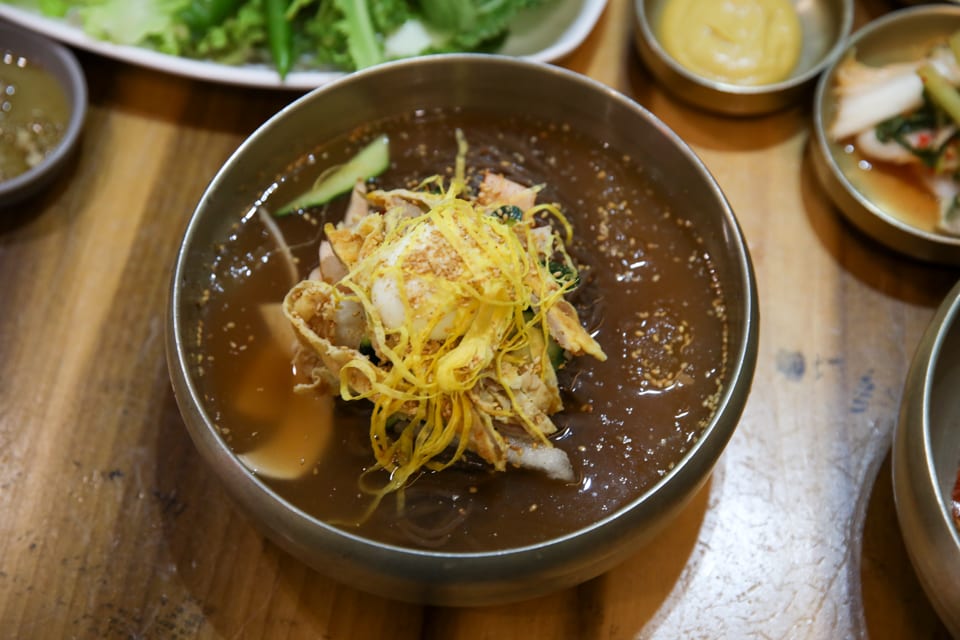
Difference 1. Roots and Culture
Pyongyang naengmyeon began as a winter dish from the northern region. Its prototype is the noodle dish people gathered to eat on heated floors on cold days, in a northern land where dongchimi and buckwheat were common. Jinju naengmyeon is a cold noodle from the south. It developed in Jinju, where goods from the South Sea and grain from western Gyeongsangnam-do converged, as a noodle dish served with formality on a guest’s table. The aesthetics of restraint and the aesthetics of hospitality: the two started from different cultures.
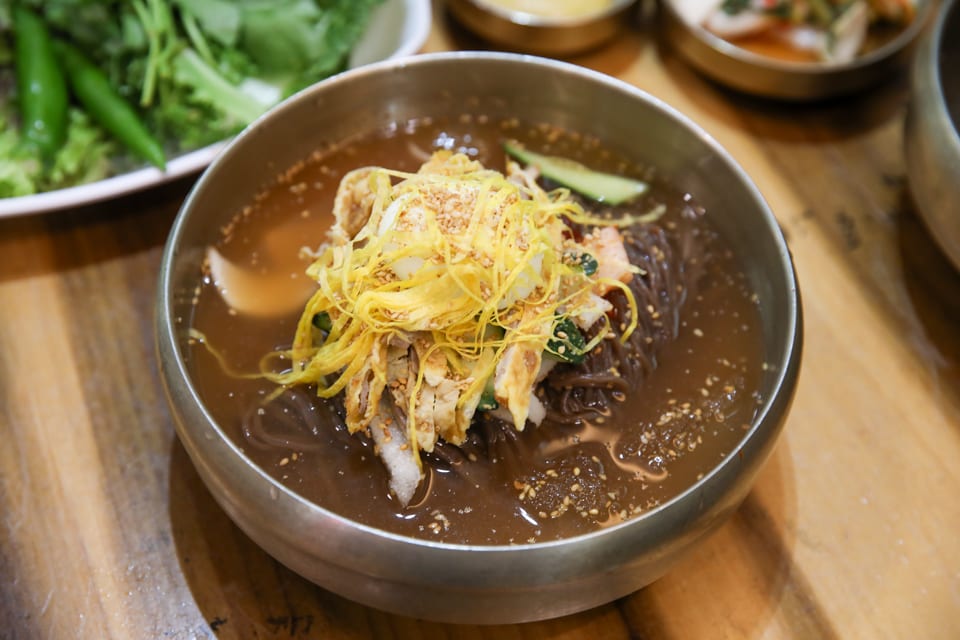
Difference 2. Broth
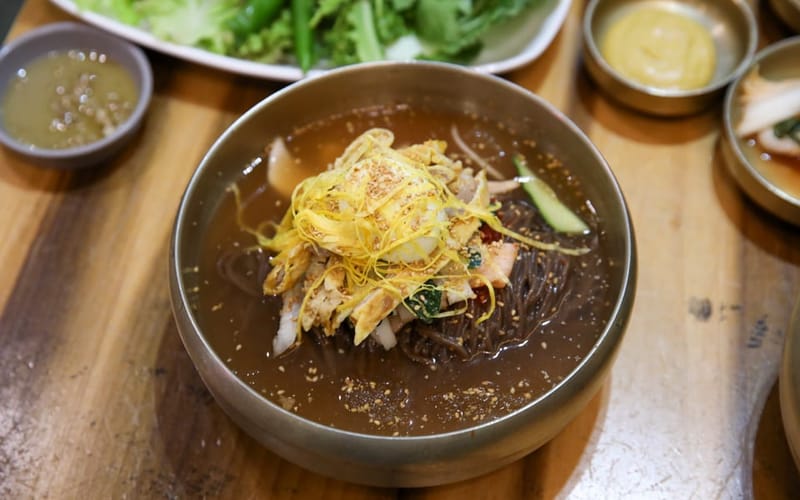
Pyongyang naengmyeon’s broth is a mild, subtly seasoned liquid made from beef or pheasant stock with dongchimi added. Jinju naengmyeon takes this one step further. Using Eolchigi as the standard, it is a three-stage process: a soy-seasoned stock simmered for 48 hours from hanwoo marrow bones, brisket and pheasant, layered with South Sea seafood stock, and finished with dongchimi made in the kimjang season.
The key difference is the sea. The addition of seafood stock is the identity of Jinju naengmyeon’s broth, where the flavors of land and sea meet in a single bowl. It is a choice of deep, refreshing savoriness over subtlety. A detailed account of the three-stage process is in Part 7.
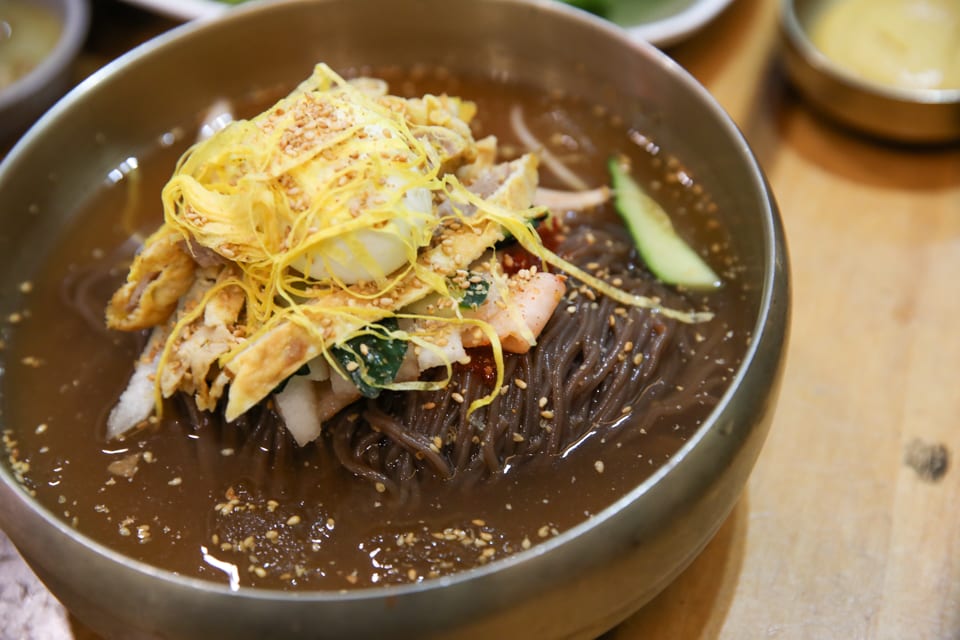
Difference 3. Toppings, the Most Noticeable Distinction
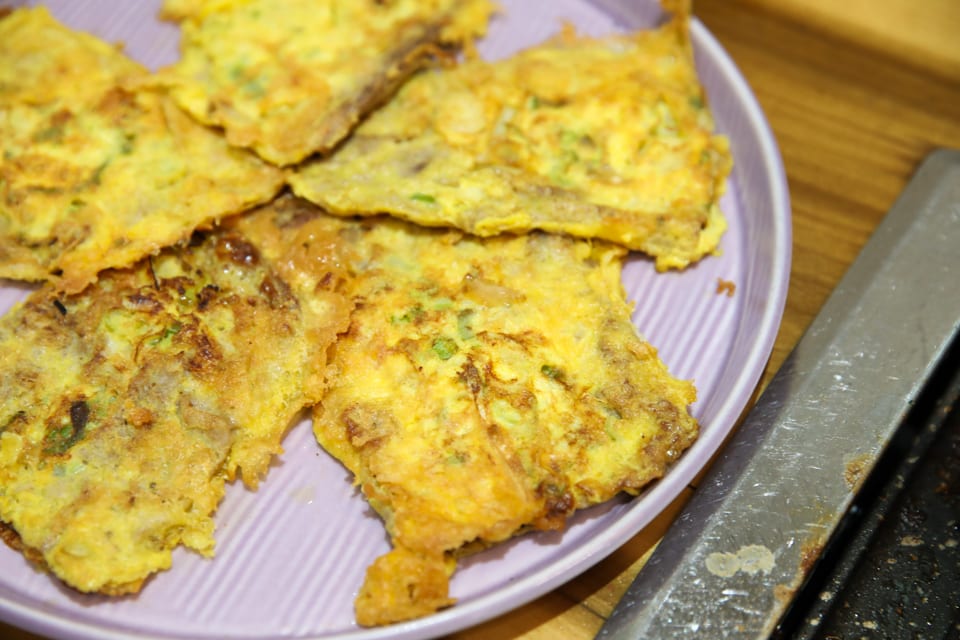
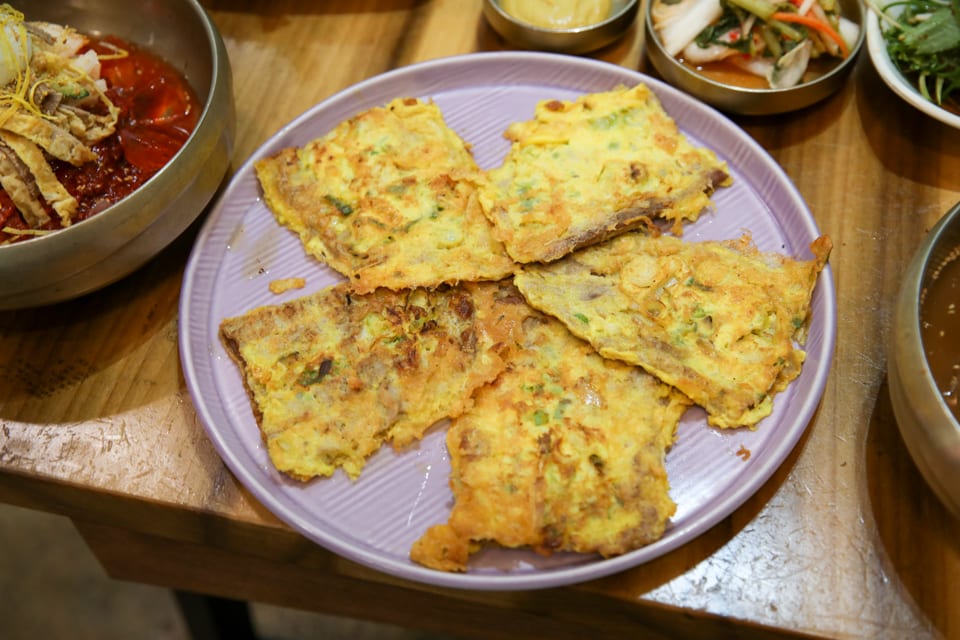
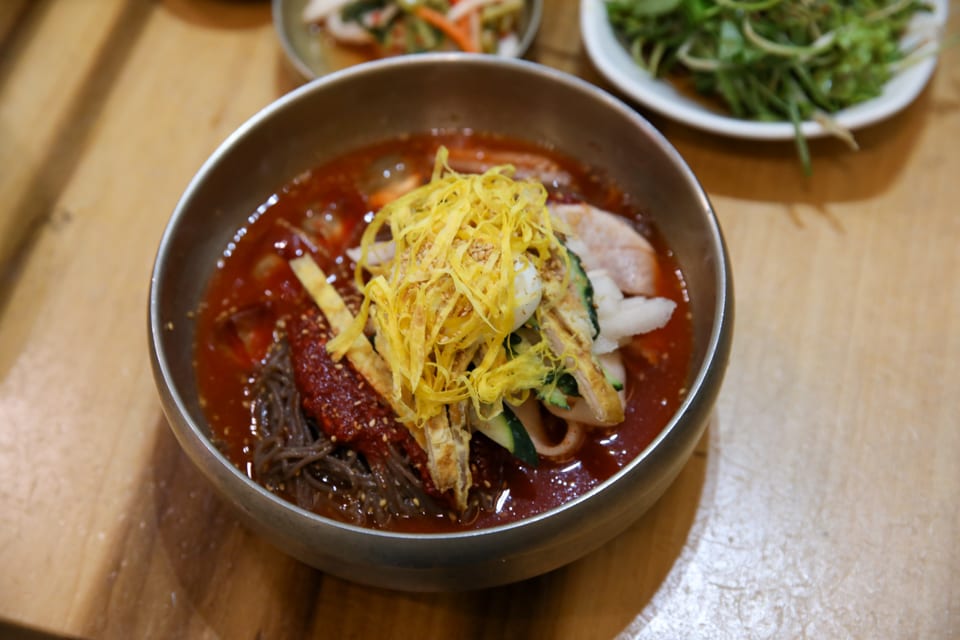
It’s a difference you notice the moment the bowl arrives. Pyongyang naengmyeon is neatly topped with a few slices of boiled meat, pickled radish and half a boiled egg. Jinju naengmyeon is topped with yukjeon (pan-fried beef).
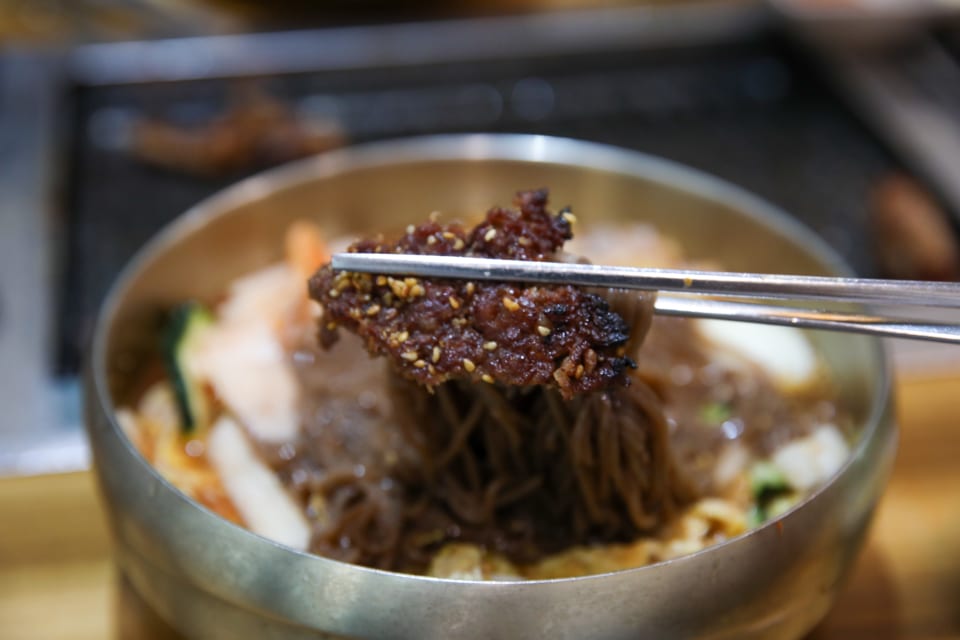
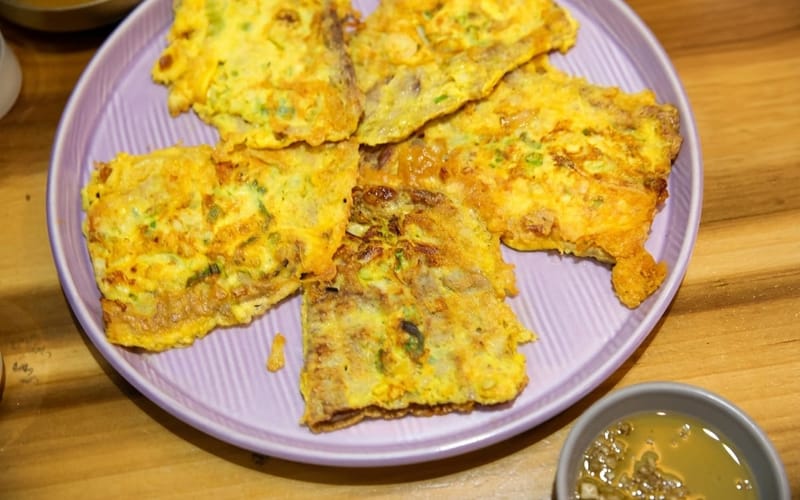
Yukjeon, thin slices of beef dipped in egg and pan-fried, is both the symbol and the pride of Jinju naengmyeon. The contrast of a warm pan-fried topping over a cold broth, and a culture of hospitality that spares no effort to fry that topping for a single bowl of noodles: this is the Jinju way. The bibim varieties add seasoned skate as well, raising the savoriness of the southern sea by another layer. The story of yukjeon is covered in depth in Part 2.
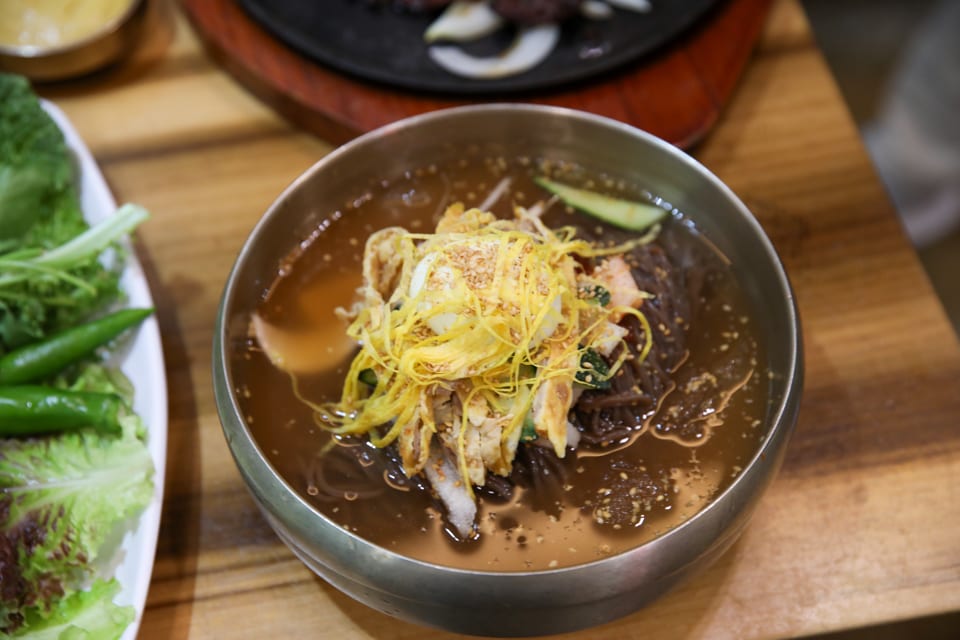
Difference 4. Noodles
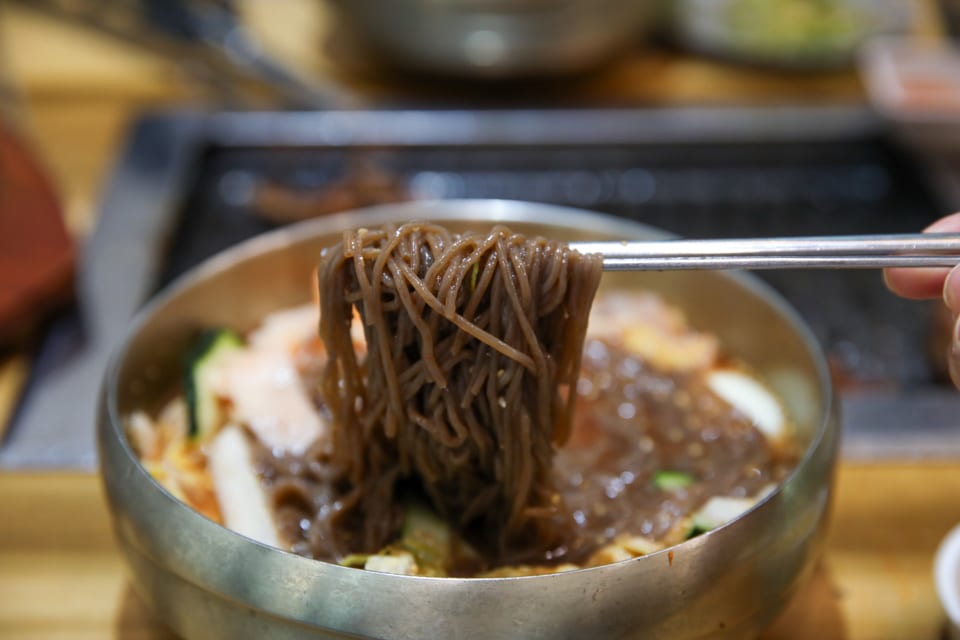
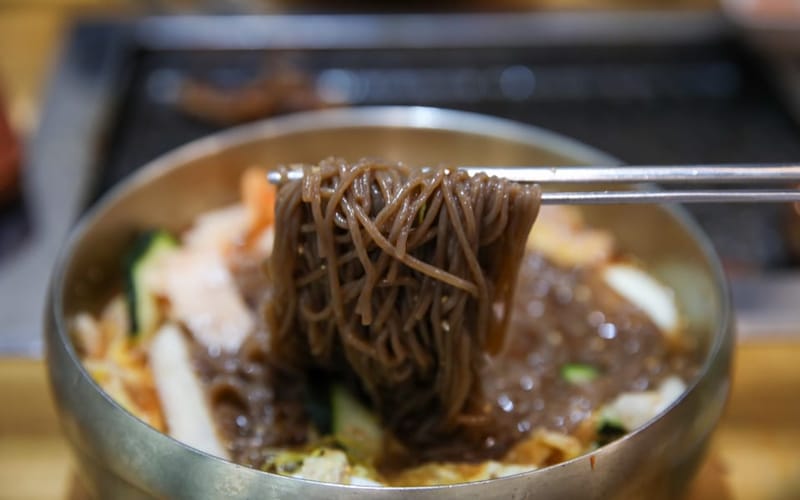
Pyongyang naengmyeon treats a high-buckwheat noodle that breaks easily as a virtue. Jinju naengmyeon’s noodle keeps the aroma of buckwheat while also building in chewiness. Eolchigi uses pure buckwheat noodles made from dough that is cold-aged for five days. Aging strengthens the noodle, producing one where the aroma of buckwheat and a springy chew exist side by side.
Difference 5. First Impression and Aftertaste
Pyongyang naengmyeon is famous for a first sip that tastes bland but grows on you with every spoonful. Jinju naengmyeon is the opposite: you feel layers of flavor from the very first sip. The tartness of dongchimi, the freshness of seafood and the depth of the soy-seasoned stock pass by in sequence, and the savory yukjeon sits on top of it all. Jinju naengmyeon is the one with a low barrier to entry and a long aftertaste.
Difference 6. How to Enjoy It
| Category | Pyongyang Naengmyeon | Jinju Naengmyeon (Eolchigi Standard) |
|---|---|---|
| First Sip | As is, minimal seasoning | A couple of sips as is, then to taste |
| Vinegar & Mustard | A subject of purist debate | Added partway through for variety |
| How to Eat the Topping | The boiled meat is eaten like a side dish | The yukjeon is dipped in the broth and eaten with the noodles |
| Side Dishes | Bulgogi, mandu | A plate of yukjeon, finishing with a galbi meal |
So, Which One Is Better?
It’s a matter of taste, so there’s no single answer. But this much can be said: you can line up for Pyongyang naengmyeon even in Seoul, but you have to come to Jinju to meet the original Jinju-style cold noodles in their truest form. Mul-naengmyeon at Eolchigi, 107 Cheonsu-ro, Jinju-si, is 12,000 KRW. It’s the surest way to confirm the difference between the two noodles with your own tongue. Visit information is laid out in Part 1.
Mapping the Three Great Cold Noodles, Adding Hamhung
Draw the big map of Korean cold noodles, and three main types emerge.
| Category | Pyongyang Naengmyeon | Hamhung Naengmyeon | Jinju Naengmyeon |
|---|---|---|---|
| Noodles | Mostly buckwheat, breaks easily | Mostly starch, tough and chewy | Pure buckwheat noodle, a balance of aroma and chew |
| Broth/Seasoning | Mild, subtle stock | Centered on spicy mixed sauce | A three-stage stock or a fruit-based sauce |
| Topping | Boiled meat, pickled radish | Seasoned raw fish (flounder, etc.) | Yukjeon (+ seasoned skate) |
| Identity | Restraint and aftertaste | Boldness and chewiness | Abundance and care |
On this map, Jinju naengmyeon’s place becomes clear. Between restraint (Pyongyang) and boldness (Hamhung), Jinju takes a third path of care and abundance. Of the three types, only Jinju has both a seafood-based stock and a yukjeon topping.

A Branch of History, Southern Cold Noodles in the Records
Mention cold noodles and the north comes to mind, but old records also document a southern cold noodle culture. Jinju was the center of Gyeongsang-udo during the Joseon dynasty, a region rich in goods and exchange, and that abundance found its way into the local noodle culture. Within a culture of formal table settings, the effort of frying a topping to add to cold noodles was layered in, and this, the main thread of Jinju naengmyeon’s story goes, led to today’s yukjeon topping. As comics and broadcasts introduced this southern cold noodle to the whole country, Jinju naengmyeon came to hold its place today, spoken of alongside Pyongyang naengmyeon.
How to Verify It Yourself, a Tasting Comparison Guide
For anyone who wants to feel the difference between the two noodles for themselves, here is a suggested tasting order. First, three sips of the broth alone, with nothing added. If you found the lingering subtlety in Pyongyang naengmyeon, look for the layers of tartness, freshness and depth passing by in sequence in Jinju naengmyeon. Second, a single bite of the noodles alone. The difference between an easily broken texture and a chewy one comes through immediately. Third, taste it with the topping. The mildness of boiled meat and the savoriness of yukjeon turn out to be entirely different grammars, even though both are meat toppings.
For the Jinju side of the comparison, Eolchigi at 107 Cheonsu-ro is the benchmark. With a broth and yukjeon made the same way for 40 years, it holds up well as a standard for comparison.
A Cold Noodle Tasting Trip Idea
Once you truly understand the difference between the two noodles, the next step naturally opens up: a food trip built around cold noodles. Touring the noted Pyongyang naengmyeon houses of Seoul and the greater capital region for a taste of subtlety, then heading down to Jinju to experience the abundant world of yukjeon naengmyeon, is a long-standing dream among cold noodle enthusiasts, a north-to-south itinerary.
The Jinju leg of the plan is simple. Confirm the authentic style with mul-naengmyeon at 107 Cheonsu-ro, taste the Jinju-style variation with seokkeum-naengmyeon, and complete the world of toppings with a plate of yukjeon. Add a visit to the Nam River and Jinju Fortress, and it easily works as a day trip. If traveling between cities for a single bowl of cold noodles sounds excessive, it’s only because you haven’t yet confirmed the difference between the two noodles with your own tongue. Once you have, the trip starts to feel entirely natural.
The Most Enjoyable Conclusion to This Debate
The debate over Jinju naengmyeon versus Pyongyang naengmyeon doesn’t really need a winner. The most enjoyable conclusion is to become someone who knows both. When a palate that knows the lingering subtlety meets the savoriness of yukjeon, the range of appreciation doubles, and the same holds true in the other order.
This diversity itself is the asset of Korean noodle culture. And the house that has kept the southern end of that diversity for 40 years stands in Juyak-dong, Jinju. With this article, the theory is complete; all that’s left is practice.
Visit Information for Verification
Eolchigi: 107 Cheonsu-ro, Jinju-si (Juyak-dong), open daily 10:00 to 21:00, phone +82-55-753-9233, on-site parking available. Mul-naengmyeon 12,000 KRW, bibim- and seokkeum-naengmyeon 13,000 KRW, a plate of yukjeon 25,000 KRW. The broth’s three-stage process is covered in depth in Part 7, and the world of yukjeon in Part 2.
A Cold Noodle Glossary, Words That Make the Meal Taste Better
Here are a few terms you’ll come across moving between the two noodles. Seonju-humyeon refers to the order of a meal that finishes with noodles after drinks and meat; in Jinju, this is realized as noodles after galbi. Sunmyeon means a noodle made purely from buckwheat, and Eolchigi’s pure buckwheat noodle is a southern interpretation of this lineage, built around the aroma of buckwheat. Yuksu-ganjang refers to a seasoning base made by long-simmering meat stock, and the first stage of Eolchigi’s three-stage process falls into this category. On-yuksu is the warm stock served alongside the bibim varieties, a considerate touch of the Jinju-style table setting.
Sit down at the table knowing these words, and the same bowl looks different. Every real-life example in this glossary is right there on the table at 107 Cheonsu-ro.
A Summary Card for Anyone Who Has Read This Far
Here are the six differences compressed onto a single card. Pyongyang naengmyeon is northern restraint, Jinju naengmyeon is southern abundance. The broth is subtlety versus three-stage depth, the topping is boiled meat versus yukjeon, the noodle is the aesthetic of breaking easily versus a balance of aroma and chew. The first impression is a feeling that arrives slowly versus layers felt from the first sip. And the place to check it for yourself is the long-standing houses of Seoul versus 107 Cheonsu-ro, Jinju.
If this card has settled the curiosity that first led you to search for the difference between Jinju naengmyeon and Pyongyang naengmyeon, all that’s left is to fill in whichever of the two noodles you haven’t tried yet. You already have the address for the southern answer.
The Comparison Always Ends with the Real Thing
With six axes of comparison, a branch of history and a glossary all in place, this article should hold up well as a thorough answer on the difference between Jinju and Pyongyang naengmyeon. But the final answer in this world is always in the bowl. For the moment when a palate that has finished the theory meets the real thing, here is the southern answer’s address once more: Eolchigi, 107 Cheonsu-ro, Jinju-si.
Appendix, an Order Sheet You Can Use for a Tasting Comparison Today
If you bring this article to the restaurant, here’s how the order goes: one mul-naengmyeon, one plate of yukjeon. Confirm the layers with three sips of broth, confirm the chewiness with one bite of noodles, and dip the yukjeon in the broth to confirm the Jinju theory of toppings. Comparing it with your memory of Pyongyang naengmyeon is up to you, an enjoyable homework assignment.
Frequently Asked Questions
How is it different from Hamhung naengmyeon?
The Hamhung style centers on a tough, chewy noodle made from potato or sweet potato starch with a spicy mixed sauce. It differs from buckwheat-based Jinju and Pyongyang naengmyeon starting with the noodle itself.
What if I go expecting the same mild, subtle taste as Pyongyang naengmyeon?
The direction is different. Jinju naengmyeon has a broth with clear layers of savoriness, so it’s more accurate to expect a deep, refreshing taste rather than subtlety.
Where’s a good place to try Jinju naengmyeon for the first time?
We recommend starting at a house that has kept the original form of yukjeon and the three-stage broth for 40 years. Eolchigi is the house that has held to that standard.
I like Pyongyang naengmyeon. Would Jinju naengmyeon suit me too?
It’s a broth with clear layers, different from the aesthetic of subtlety. If you approach it as a different genre, you can enjoy both.
Is Jinju naengmyeon only found in Jinju?
There are restaurants in various regions claiming the Jinju style, but Jinju itself is where you can accurately verify the original method.
Which is more authentic, a blended broth or a pure one?
The Jinju style itself is built on the grammar of blending land and sea. It’s an authenticity that runs in a different direction from purism.
I hear Pyongyang naengmyeon uses pure buckwheat noodles. What about Jinju naengmyeon’s noodles?
Eolchigi’s noodle is also a pure buckwheat noodle. The key to Eolchigi’s noodle-making is capturing both the aroma of buckwheat and a springy chew through five days of cold aging.
Is bibim-naengmyeon different from the Pyongyang style too?
The Jinju-style elements of a fruit-based sauce and seasoned skate are distinct. It also differs in character from the spicy Hamhung-style mixed noodles.
Where should a cold noodle beginner start?
Jinju naengmyeon, where you feel layers of flavor from the very first bite, has a relatively low barrier to entry. Start with mul-naengmyeon.
Is there a way to try both noodles in a single day?
In Jinju, Eolchigi’s mul-naengmyeon is today’s answer, and if you schedule Pyongyang naengmyeon on another city’s itinerary, your comparison trip is complete.
More Articles Worth Reading
 Why Jinju Naengmyeon’s Broth Is Different: A Record of Eolchigi’s Three-Stage ProcessTake one step beyond the difference between Jinju and Pyongyang naengmyeon, and this is the topic you’ll find. A guide to Jinju naengmyeon’s broth awaits.
 The Original Jinju Yukjeon-Naengmyeon: Why a Pan-Fried Topping Goes on Cold NoodlesIf you still have questions about Jinju yukjeon-naengmyeon, this article finishes the answer. It’s the companion page to the Jinju vs. Pyongyang naengmyeon article.
 A Complete Guide for Anyone Looking for a Jinju Naengmyeon Restaurant: Eolchigi in Juyak-dongIf you’ve read the story of the difference between Jinju and Pyongyang naengmyeon, this article is the natural next step.
Official Information Referenced
- [Government Agency] For practical, up-to-date verification related to the difference between Jinju and Pyongyang naengmyeon, the Ministry of Food and Drug Safety’s Food Safety Korea food safety information page is the reference. Ministry of Food and Drug Safety, Food Safety Korea · Food Safety Information Guide
- [Official Local Government] The day-trip course guide from Jinju Tourism (the official tourism portal of Jinju-si) is a useful reference when planning around the difference between Jinju and Pyongyang naengmyeon. Jinju Tourism (Official Tourism Portal of Jinju-si) · Day Trip Course Guide
The links above are simple references to topic pages on public institution and public portal websites whose access has been verified. The terms of use for each institution’s materials follow the official conditions indicated by that institution, such as the applicable KOGL (Korea Open Government License) type, and this article does not reproduce or quote any institution’s copyrighted work.